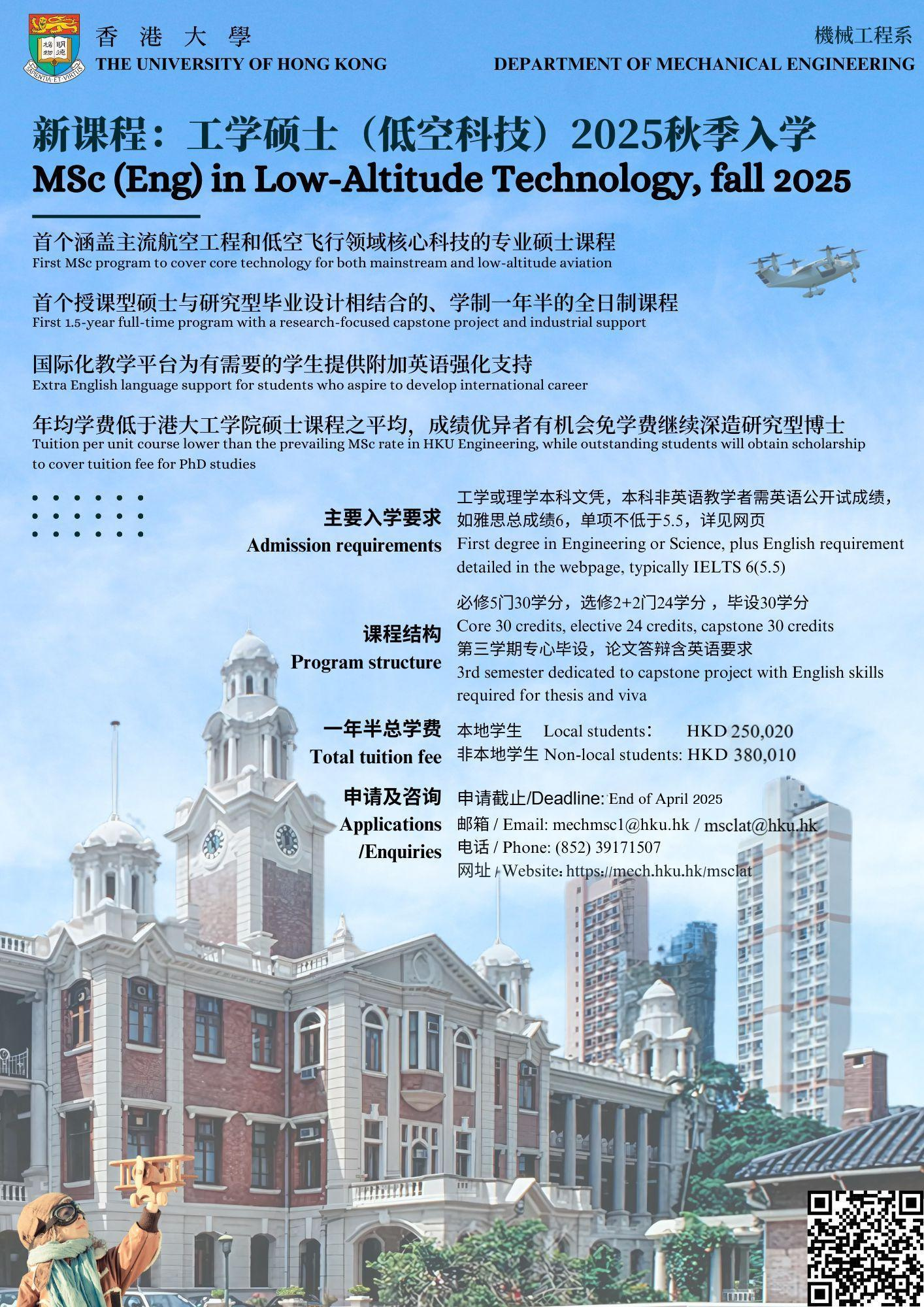
MSc(Eng) in Low-Altitude Technology(LAT) Admission open
Deadline: End of April 2025
Programme Aims
(a) To provide students with a strong theoretical foundation and practical design insights for low-altitude aerial vehicles and their safe operation. The graduates should also be able to contribute to the mainstream aerospace industry with new ideas gained in low-altitude designs.(b) To embrace innovation and entrepreneurship opportunities in the emerging sector of the low-altitude economy with personal, commercial and industrial applications. (c) To foster a regional and international platform of collaboration where scientists, engineers, economists, policy makers and scholars mingle to create a shared vision of 3D transport.
About Programme

Programme Structure
Students are required to complete 84 credits and a substantiated dissertation to fulfil the graduation requirement, normally over 1.5 academic years of full-time mode of study as set out below:
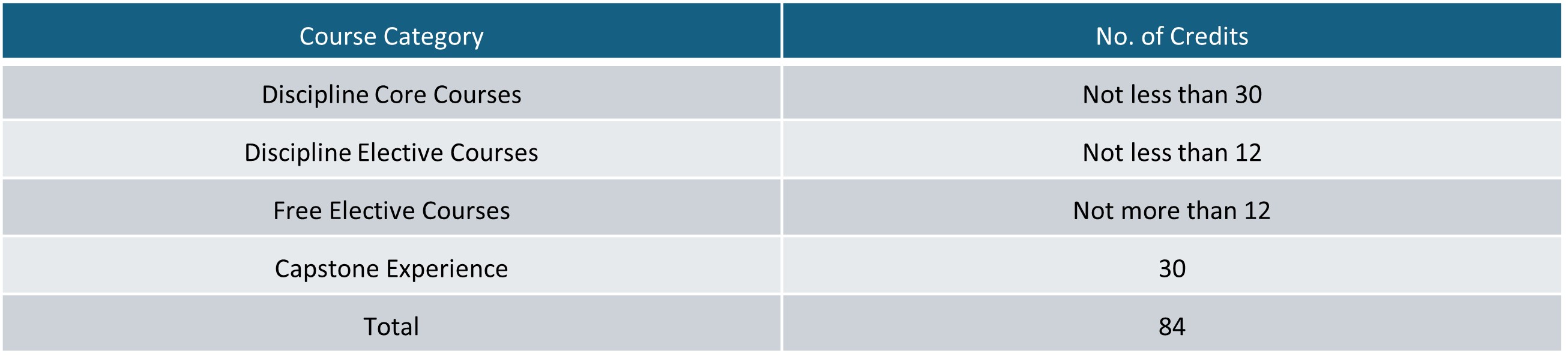
Candidates shall select courses in accordance with the regulations of the degree. Candidates must complete i) 10 courses, including 6 courses from List A and 2 from List B, and ii) a dissertation. They may select no more than 2 course offered by other taught postgraduate curricula within or beyond the Faculty of Engineering as free electives. All course selection will be subject to approval by the Programme Director(s). For the discipline elective courses, students may choose at least 2 from the areas of Aerodynamics and its computation, Aircraft stress analysis and finite element, Telecommunications systems and management, Noise and vibration, Battery technology, Global logistics and transportation systems, and Aviation economics: business model and entrepreneurship. Additionally, students can select no more than two free elective courses from within or beyond the Engineering Faculty to gain deeper knowledge in different engineering fields.

Contacts and Enquiries

COURSE DESCRIPTION
The following is a list of discipline courses. The list of courses below is not final and some courses may not be offered every year. All courses are assessed through examination and/or coursework assessment, the weightings of which are subject to approval by the Faculty Board.
List-A Discipline core courses
LATX7511. Effective English speaking, listening and writing (non-credit bearing and not compulsory (see “Curriculum Structure” in the previous Section))
This course aims to enhance students’ level of English in the context of mechanical and aeronautical engineering. Upon course completion, it is hoped that participants can approach
academic writing, speaking and listening comprehension with greater confidence. The course emphasizes hands-on practice and individualized feedback to help students develop the necessary
academic English skills for success in their study discipline and future work in high-tech industry. Key topics include: [1] Presentation skills: organizing and delivering effective technical presentations; utilizing
visual aids and multimedia effectively; engaging the audience and handling questions;[2] Listening comprehension skills: identifying key information and main ideas in lectures;
developing effective note-taking strategies; comprehending technical presentations and academic discussion;[3] Dissertation writing skills: understanding discourse features and language used in reviewing
literature (making the research gap explicit, stating hypotheses or research questions); reporting and discussing research results; using signposts, verb tenses, and hedging devices in dissertation
writing; paraphrasing and summarizing academic sources; and learning how to avoid plagiarism.It will begin with enhancement of listening comprehension and presentation skills via a series of
recorded technical seminars on low-altitude economy and its latest technology advancement before students taking other core subjects in semester 1. The course will then be embedded in the
students' research project work for two semesters via three presentations: literature survey and project outline, interim project report, and final oral defense. Assessment: 100% in-class practice and coursework.
LATX7512. Aeronautical practice and prospects (6 credits)
This is a credit-bearing learning experience in industrial setting leading to an essay on the future
of aerospace technology and/or entrepreneurship plans. Visits will be arranged to (1) passenger
airplane design and manufacturing company, (2) aircraft engine or gas turbine company, (3)
facility of unmanned aerial vehicles. Seminars will be given by leading industrialists and
academics to discuss current practices, cost, certification, technology and trends, in aeronautics
and general aviation during the visits. A small workshop is then held to discuss business elements
leading to entrepreneurship in low-altitude economy.Assessment: 100% continuous assessment based on essay/reports.
LATX7513. Fundamentals of aircraft and aviation (6 credits)
This course aims to present an overall view of aircraft and its operation, with extension to lowaltitude technology. It begins with the types of aircrafts and other flying vehicles including
helicopters, drones and eVTOLs. It then focuses on small-medium sized fixed-wing aircraft and
discusses the wing-fuselage-landing gear configurations, engine selection, hydraulic and
electrical systems, vehicle stability & control derivatives, control and flight safety, data and
navigation, design mission leading to flight dynamics analysis (static equilibrium & trim,
aerodynamic modelling, range estimate), and initial size estimates for key vehicle parts. Assessment: 50% Continuous assessment, 50% written examination.
LATX7514. Propulsion technology (6 credits)
This course aims to provide essential knowledge on aircraft engine which plays the key role in
aeronautical engineering. It begins with a review of thermodynamic cycle based on a turbojet
engine, and the introduction of turbo-shaft, turbo-prop and turbofan engines. It then extends
upwards to ramjet/scramjet and rocket propulsion, hybrid engine for aerospace flights, and
downwards to low-altitude options including use of battery and distributed, electrical propulsion
fan configurations for eVTOL, thermal management of batteries. The second part of the course
focuses on standard turbofan engine components including component calculations leading to
specific fuel consumptions, fundamentals of turbomachinery fluid dynamics (axial and
centrifugal), engine stability, combustion, pollution and alternative fuels, and conclude by a brief
discussion on engine structures and materials challenges, and future developments.Assessment: 40% continuous assessment and 60% written examination.
MECH7020. Autonomous drones with AI (6 credits)
This course aims to explore the key Artificial Intelligence (AI) techniques for a small-scale,
unmanned aerial vehicle (UAV), including sensor calibration, navigation systems, and AI-based
control techniques. The specific course objectives are as follows: 1) To have an overall
understanding of UAVs: system configurations and applications. 2) To study the AI-based
planning and control techniques for small-scale UAVs, such as nonlinear dynamic inversion and
optimal control. 3) To understand the AI-based navigation techniques in modern small-scale
UAVs, such as GPS / IMU navigation, visual-inertial navigation, and light detection and ranging
(lidar) navigation. 4) To conduct experiments on state-of-the-art AI-based navigation and control
techniques for actual UAVs. This course covers the following topics: UAV configuration; UAV materials; innovative design
methodology; dynamics and modelling; motion planning; path planning and obstacle avoidance;
classic UAV control; modern AI control; optimal and nonlinear control; navigation; state
estimation; sensor fusion; visual odometry and lidar odometry; Simultaneous localization and
Mapping (SLAM).Assessment: 100% Continuous assessment.
LATX7515. Aeronautical materials and manufacturing (6 credits)
This course aims to present the unique properties aeronautical materials must possess for
aeronautics: light-weight, high strength, heat and corrosion resistant, and sometimes with
compromise of manufacturability. It begins with a review of different categories of materials
needed for aircraft frame and engine components: titanium, steel, aluminium, composites with
polymers, carbon fibre, fibre-reinforced laminates, and high-temperature alloys for turbines,
ceramics, and material considerations for small aircrafts. The introduction to these materials will
cover fundamental materials science concepts such as phase diagram, diffusion, strengthening,
creep damage, etc. The second part of the course introduces manufacturing processes unique for
aircraft-specific composites, structural light-weight alloys and hot-section alloys in aero-engines.
In particular, various additive manufacturing techniques, including direct energy deposition and
powder bed fusion methods, and their applications in aerospace industry will be reviewed.
Emphasis is placed on the “processing-microstructure-property” relationship of 3D printed
aerospace alloys through case studies. Challenges and considerations related to material integrity,part quality, and post-processing requirements will also be discussed. The course concludes by
techniques needed for non-destructive defect detection and other aspects of material life-span. Assessment: 10% practical work, 30% continuous assessment, 60% examination.
List-B Discipline elective courses
MECH7022. Aerodynamics and its computation (6 credits)
This course aims to provide the advanced knowledge of fluid mechanics necessary for
aeronautical and related engineering applications. It is combined with the basic computational
fluid dynamics (CFD) so that the student can use CFD to explore the topics learned. It begins
with a review of fundamental fluid mechanics concepts of boundary layer flow, Navier-Stokes
equation and solution for simple laminar flows, lift-generation mechanism on a flat plate,
followed by basic CFD concepts of finite difference discretization, boundary conditions, meshing,
orders of numerical accuracy, convergence, dispersion and dissipation, compact high-order
schemes, time-marching schemes, finite volume method. A software package is then introduced
to familiarize with the basic flow phenomena and compare with analytical or empirical theories,
such as the lift-drag ratio over different airfoil designs, flow separation, vorticity shedding behind
bluff bodies, flow through blade cascades. Assessment: 40% continuous assessment, 60% written examination.
LATX7516. Aircraft stress analysis and finite element (6 credits)
This course focuses on typical mechanical problems of aircraft in the operating environment. The
deformation behavior of the airframes is analyzed by finite element method, which could provide
a reference for safety assessment and optimization design of components. The main contents are
as follows: (1) The theoretical basis of elasticity, including three-dimensional stress, strain,
constitutive relations and basic equations, plane problems, and plate bending; (2) Aircraft load
estimates for normal operation, maneuver and gust; (3) The theoretical basis of plasticity,
including microplasticity, continuum plasticity, and elastic-plastic analysis; (3) Introduction to
finite element method and typical software package, finite element analysis of aircraft
components. Assessment: 40% continuous assessment, 60% written examination.
ELEC6080 Telecommunications Systems and Management (6 credits)
This course aims to provide a comprehensive understanding of major telecommunications
systems (i.e. fixed, mobile, wireless, etc.), and contemporary management practices (e.g. strategy
planning, product development, marketing, customer service, etc.) in telecommunications
systems. It helps students to appreciate the integration of multi-disciplinary knowledge in
telecommunications sectors. The course also covers some more advanced topics in the ICT
industry including next generation networks (e.g. NGA such as FTTx, HSPA+/4G/LTE, HetNet,
etc.), convergence development (i.e. device, network, service, sector, etc.), multiple-play and
OTT services. Assessment: 40% continuous assessment, 60% written examination.
MECH6017. Noise and vibration (6 credits)
This course aims to provide an integrated treatment for vibration system, noise radiation and the
available control methods in engineering. Upon completing this course, the students are expected
to: (1) explain the basic characteristics of a simple vibration system; (2) understand the
mechanism of noise radiation by structural vibration and turbulent flow, and its impact on human
hearing; and (3) offer solution to typical noise control problems. Topics include: human hearing; environmental legislation and guidelines; fundamentals of
vibration and vibration isolation; sound radiation by vibration, turbulent flow and turbomachinery;
sound propagation and duct acoustics; noise absorption and reflection; control of noise at the
source; physics of active control; finite element solution for linear acoustics.Assessment: 70% written examination, 20% continuous assessment, 10% practical work.
MECH7023. Battery technology (6 credits)
Battery technology has been developing rapidly as a major component to achieve carbon-neutral
or zero-carbon technology. This includes both overall power grid and specific applications such
as electrical land vehicles and aviation, as well as consumer electronics. This course will begin
with the basic electrochemistry and the manufacturing process of typical batteries based on Li,
Zn, Ni etc, introduce designs like fuel-cells, and focus on development for high energy density,
e.g. lithium-sulfur and solid-state, fast charging, longevity and good safety features. Using the
latest technology trend in large UAV and eVTOL as a very demanding example, the course will
also cover transitional hybrid design with traditional fuel backup, advanced energy management system, including real-time monitoring techniques, and regulatory framework. Assessment: 40% Continuous assessment, 60% written examination.
DASE7222. Global logistics and transportation systems (6 credits)
Global operations and logistics strategies, strategic changes required by globalization, the
strategic framework for global operations, the role of logistics in global operations and marketing
strategies; global operations and logistics planning, supplier network development, physical
distribution, global logistics network design, global supply chain management, risk management
in global operations; management of global operations and logistics, operations analysis of global
supply chains, information management for global logistics, performance measurement and
evaluation in global logistics. Assessment: 40% Continuous assessment, 60% written examination..
LATX7517. Aviation economics: business model and entrepreneurship (6 credits)
This course introduces students to the core concepts of business model and entrepreneurship with
a special emphasis on their application in low altitude aviation projects. Students will learn the
fundamental and tools in cost structure, financial planning, supply chain and be exposed to the
key processes, challenges, risks and rewards in the related entrepreneurial business. Students will
use this understanding to develop and evaluate the aviation design. They will also learn to apply
the concepts and knowledge learned in the course to develop a business plan that could be
presented to key stakeholders which includes potential investors. Students will be learning from
real-life examples in this specific industry. Assessment: 100% continuous assessment (20% case studies, 70% project-based, 10% class participation)
LATX7501. Dissertation (30 credits)
Dissertation is an integral part of the curriculum requirement. The student will work individually
or in small group with individualized project objectives, under the supervision of a qualified
academic staff. In many cases, the student will also have an industrial tutor. The involvement of
industrial tutor will be paired with academic supervisor to ensure that our industrial partners fully
understand the university practice and follow all the quality assurance steps. The purpose of the project is to integrate what the students have learned in the previous stage and demonstrate his/her
capability to use the knowledge to solve real-world design problems relevant to low altitude flights,
its business model or related regulatory issues. The project can take place either in university labs,
or industrial setting. Take the most typical design project as an example, the student is expected
to demonstrate his/her awareness of literature knowledge (state-of-the-art), capability to tackle a
design task with a certain degree of innovation, improvement over existing performance or
insightful analysis of why certain designs do not work as desired. Apart from technical attributes,
the student is also expected to demonstrate effective English communication skills in verbal and
written forms. These will be assessed by qualified English teachers who will sit in the project
opening presentation, intermediate progress report and final report presentations. Provisions will
be made for students to benefit from interactions with English teachers prior to and following
these presentations. Assessment: 100% continuous assessment [Interim review (5%), Objective, Methodology and
Originality (5%), Working Attitude and Initiative (10%), Overall Achievement (25%), technical
aspects of Oral presentation (15%) and Project Report (20%), language aspects of Oral
presentation and Project Report (20%)]